Desserts · Part 2 of 3: Instructions
Chocolate Sauerkraut Cake with Glossy Fudge Frosting Step-by-step instructions
- Prep
- Cook
- Total
- Serves
- 12
Before you start
Set out the eggs and butter about 30 minutes ahead so the eggs incorporate smoothly and the butter melts quickly without scorching. Line the 9x13-inch pan with parchment, leaving an overhang on the two long sides, and position a rack in the center of the oven.
Give the sauerkraut its full rinse, squeeze, and chop before anything else; wet, long shreds will sink and clump. Pre-measure the frosting ingredients too, since it comes together fast once the chocolate melts. Have a toothpick, a wire rack, and a hot knife ready so nothing stalls at the finish line.
Ingredients at a glance (17)
- 1 cup sauerkraut, drained, rinsed and finely chopped
- 1 3/4 cups all-purpose flour
- 3/4 cup unsweetened cocoa powder
- 1 1/2 cups granulated sugar
- 1/2 cup light brown sugar, packed
- 1 tsp baking soda
- 1 tsp baking powder
- 1/2 tsp kosher salt
- 1/2 cup unsalted butter, melted and cooled
- 2 large eggs
- 2 tsp vanilla extract
- 1 cup hot water
- 8 oz semisweet chocolate, chopped
- 1/2 cup unsalted butter, softened
- 1/4 cup whole milk
- 2 cups confectioners' sugar, sifted
- 1 tsp vanilla extract
Instructions
Prep the surprise ingredient
- Rinse and chop the sauerkrautTip the sauerkraut into a fine-mesh strainer and rinse it under cold running water for about 30 seconds, tossing with your fingers. Press out the brine firmly, then transfer to a cutting board and chop it finely, roughly the texture of shredded coconut. Set aside on a paper towel to drain further.Look for The shreds look pale, limp and short, with no visible brine pooling underneath.Tip Rinsing removes the salty tang; the sauerkraut keeps only its moisture, which is exactly what makes the crumb tender.
- Build the dry baseHeat the oven to 350°F (175°C) and line the 9x13-inch pan with parchment, leaving an overhang on the two long sides. In a large bowl, whisk together the flour, cocoa powder, granulated sugar, brown sugar, baking soda, baking powder and kosher salt, breaking up any brown-sugar lumps with your fingertips.Look for The dry mixture looks uniformly dark brown with no pale streaks of flour or sugar.Tip Whisking the leaveners and salt through the cocoa now guarantees an even rise and no bitter pockets later.
By the end of this phase, the sauerkraut sits on a paper towel looking pale, limp, and finely chopped, with no brine pooling under it, and the dry mixture fills a large bowl as a uniform dark brown powder with no pale streaks. The oven has been heating for at least 10 minutes and reads 350°F (175°C), and the parchment-lined pan sits ready on the counter. Check that the sauerkraut smells faintly sweet rather than sharply of vinegar; if it still smells strong, rinse and squeeze it once more before moving on.
Batter, pan and bake
- Mix the wet ingredientsIn a second bowl, whisk the melted butter with the eggs, vanilla extract and hot water until completely smooth and glossy. Pour this mixture into the dry ingredients and whisk gently for about 30 seconds, just until no dry flour remains at the bottom of the bowl. The batter will look thin and shiny, and that is correct.Look for No dry pockets cling to the bottom; the batter flows off the whisk in a thin ribbon.Tip Hot water blooms the cocoa, intensifying the chocolate before anything goes near the oven.
- Fold in the sauerkrautScatter the chopped sauerkraut over the batter and fold with a spatula, scraping the bottom and sides, until it is evenly distributed, about 20 strokes. Pour the batter into the prepared pan and smooth the top. Tap the pan once on the counter to release any large air bubbles.Look for Dark shreds appear evenly through the batter with no clumps settled in one corner.Tip Fold rather than stir; overworking the flour now would tighten the crumb and undo the tenderness you are after.
- Bake until setBake at 350°F (175°C) for 35 to 40 minutes, rotating the pan once halfway through. The cake is done when the top springs back lightly and a toothpick inserted in the center comes out with a few moist crumbs but no wet batter. Cool completely in the pan on a wire rack before frosting.Look for The edges pull slightly from the sides and the center no longer looks wet or shiny.Tip Start checking at 35 minutes; an extra five minutes in the oven is the difference between moist and dry.
The finished batter is thin, glossy, and dark chocolate-brown, flecked evenly with short strands of sauerkraut, and it pours into the pan in a smooth ribbon. After 35 to 40 minutes at 350°F (175°C), the top springs back when pressed lightly and a toothpick comes out with moist crumbs but no wet batter. The kitchen smells deeply of chocolate with a faint caramel note from the brown sugar. Let the cake cool completely in the pan; the surface should feel cool to the touch before any frosting goes near it.
Glossy fudge finish
- Melt the chocolateCombine the chopped semisweet chocolate and butter in a saucepan set over the lowest heat, stirring often until smooth and glossy, about 4 minutes. Remove from the heat and let it cool for 5 minutes so it thickens slightly but stays pourable. Rushing this over higher heat will grainy the chocolate.Look for The mixture coats the spoon in a thick, mirror-shiny ribbon with no lumps.Tip If the chocolate seizes, whisk in a teaspoon of warm milk and it will smooth right out.
- Finish the frostingWhisk the confectioners' sugar, whole milk and vanilla extract into the warm chocolate until completely smooth. The frosting should fall in thick ribbons and hold a soft peak for a moment before sinking. Use it within a few minutes while it spreads like satin but sets to a fudge-like sheen.Look for A ribbon of frosting drizzled from the whisk holds its shape on the surface for a few seconds.Tip Sift the sugar first; even small lumps show up as white specks in the finished glossy top.
- Frost, slice and serveLift the cooled cake from the pan using the parchment overhang and set it on a cutting board. Pour the frosting over the center and spread it to the edges with an offset spatula in long strokes. Let it set for 10 minutes, then cut into 12 generous squares with a hot, wiped knife.Look for The surface turns dull and set at the edges while staying glossy in the middle.Tip Wipe the knife between cuts for clean, bakery-style squares that show off the dark crumb.
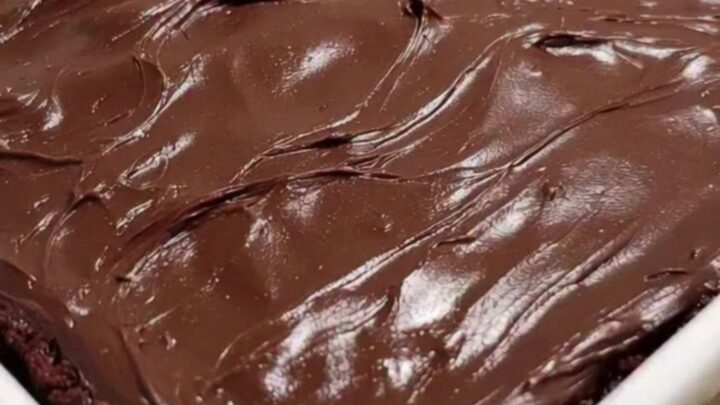
The frosting leaves the saucepan thick, glossy, and lump-free, falling in ribbons that hold for a moment before sinking. Spread over the cooled cake, it flows to the edges in smooth strokes and then sets within 10 minutes to a shiny, sliceable shell that dulls slightly at the edges first.
When cut, the squares show clean lines, a dark tender crumb, and no trace of the cabbage. If the frosting stiffens before spreading, warm the saucepan for a few seconds and stir; if it runs thin, whisk in a little more sifted sugar.
Common mistakes
The most common slip is skipping the rinse, which leaves a salty, vinegary edge that no amount of sugar hides. Rinse under cold water, squeeze firmly, and chop fine. The second mistake is overmixing after the flour goes in; stir only until the last streaks disappear, or the crumb turns tight and chewy.
Third, overbaking: this cake stays moist because it is pulled promptly, so start testing at 35 minutes. Finally, do not frost a warm cake, or the fudge topping will slide and soak in unevenly; the pan should feel fully cool to the touch.
How to tell it’s done
The cake is done when the top looks matte and slightly domed, the edges have pulled just barely from the sides of the pan, and a toothpick in the center comes out with a few moist crumbs attached but no wet batter. A gentle press in the middle should spring back rather than hold the dent.
The frosting is ready to spread when it falls in thick ribbons and holds a soft peak briefly; it sets to a fudge-like sheen within about 10 minutes. For clean squares, cut with a knife dipped in hot water and wiped dry between slices, and expect the crumb to look uniformly dark with no sign of the sauerkraut.
Up next · Part 3 of 3
4 variations · storage & make-ahead · 5 answers · printable card
Tips, FAQ & printable recipe (Part 3)← Back to the ingredients (Part 1)