Desserts · Part 2 of 3: Instructions
Decadent Chocolate Crumble Cake with Coconut Cream Filling Step-by-step instructions
- Prep
- Cook
- Total
- Serves
- 8
Before you start
Before beginning the assembly, ensure all ingredients are at the appropriate temperatures. The coconut cream must be cold to whip effectively, and the chocolate sponge should be at room temperature to avoid cracking during slicing.
Prepare your workspace by clearing enough room for the cake stand and ensuring your offset spatula and serrated knife are clean and ready.
Having your cookie crumbs in a wide, shallow bowl makes the coating process much faster and less messy, allowing you to gently press the crumbs onto the cream-covered sides with ease.
Ingredients at a glance (3)
- 1 whole chocolate sponge cake, store-bought or made ahead
- 2 cups coconut cream, chilled and whipped
- 1 cup chocolate cookie crumbs
Instructions
Slicing the Sponge
- Prepare the cake basePlace the chocolate sponge cake on a flat cutting board. Using a serrated knife, slice the cake into even layers to create a stable foundation for the filling. Handle the sponge gently to ensure it remains moist and intact during the stacking process.Look for The sponge should be cut into clean, even horizontal layers.Tip Chill the sponge for thirty minutes before slicing to reduce crumbling.
The cake layers should be uniform in thickness, providing a level base for the cream. Check that the sponge is not crumbling excessively; if it seems too dry, a light brushing with simple syrup can help maintain moisture. The edges should be clean and sharp.
Layering and Filling
- Assemble the layersSpread a generous, even layer of the whipped coconut cream over the bottom sponge slice using an offset spatula. Repeat this layering process until the cake is fully stacked. Ensure the cream is spread to the edges for a beautiful side profile.Look for The cream should be smooth and consistent across the surface of each layer.Tip Use a light touch to avoid tearing the delicate chocolate sponge cake.
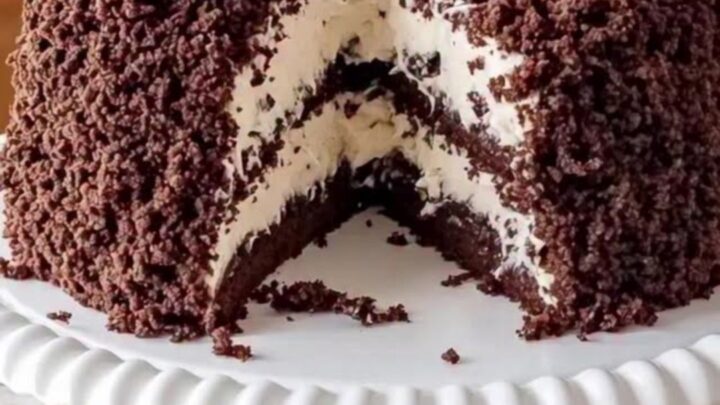
The coconut cream should be spread evenly to the very edge of each layer, creating a distinct white line that contrasts with the dark sponge. The stack should be vertical and stable. Ensure there are no large gaps or uneven piles of cream between the layers.
Coating and Setting
- Decorate and setCarefully pat the chocolate cookie crumbs all over the exterior of the cake, pressing lightly so they adhere to the coconut cream. Once fully coated, transfer the cake to a serving stand and let it set in the refrigerator for at least thirty minutes before serving. If using a custard-based cream, ensure it is heated to 160°F (71°C) during preparation to cook the eggs through.Look for The entire exterior should be covered with an even layer of dark chocolate crumbs.Safe temperature 160°F (71°C) internal temperature (egg dishes)Tip Apply the crumbs slowly to ensure a neat, professional finish on the sides.
The entire exterior must be uniformly covered with the chocolate crumbs, leaving no patches of white cream exposed. After chilling, the cake should hold its shape firmly when moved. The final texture should be a delightful mix of soft sponge and crunchy exterior.
Common mistakes
A common mistake is using warm cream, which will cause the layers to slide and the cake to lose its shape. Always ensure your coconut cream is chilled before whipping. Another error is applying too much pressure when patting the crumbs, which can drag the cream down the sides of the cake.
Use a light, gentle motion to press the crumbs into place. Finally, rushing the chilling time after assembly can lead to a messy slice; patience during the final rest is essential for a clean, professional presentation.
How to tell it’s done
The cake is ready to serve once the coconut cream has set and the crumbs are firmly adhered to the sides. The layers should feel stable when gently touched, and the cake should be cold to the touch, indicating it has set properly in the refrigerator.
A sharp, warm knife will yield the cleanest slices, revealing the distinct layers of dark sponge and white cream. If using an egg-based custard, ensure it reached 160°F (71°C) to be fully cooked.
- Egg dishes: 160°F (71°C) in the thickest part
Up next · Part 3 of 3
2 variations · storage & make-ahead · 3 answers · printable card
Tips, FAQ & printable recipe (Part 3)← Back to the ingredients (Part 1)