Dinner · Part 2 of 3: Instructions
Chipotle Pulled Pork and Mango Quesadilla in 15 Minutes Step-by-step instructions
- Prep
- Cook
- Total
- Serves
- 1
Before you start
Set up everything within arm's reach before the griddle gets hot, because once the butter foams the cook moves fast. Dice the mango into quarter-inch cubes and mince the habanero, keeping them on separate areas of the board.
Warm the pulled pork in a small skillet and drain any pooled fat, then grate the pepper jack fresh and measure a cup and a half. Lay out the tortilla, have the butter wrapper ready, and set a cutting board near the stove for the finished quesadilla.
Ingredients at a glance (7)
- 1 10-inch flour tortilla
- 4 oz chipotle pulled pork, warmed (store-bought or made ahead)
- 1/2 cup diced ripe mango (about 1/4-inch cubes)
- 1 habanero pepper, minced
- 1 1/2 cups shredded pepper jack cheese
- 1 tbsp salted butter
- Cilantro-lime crema, to taste, for serving (store-bought or made ahead)
Instructions
Prep and layering
- Dice the mango and mince the habaneroCut a ripe mango into 1/4-inch cubes, aiming for pieces small enough to sit flat inside the folded tortilla without tearing it. Mince one habanero pepper to a fine, even dice so its heat disperses through the filling instead of landing in a single fiery bite. Keep the two on separate spots of the board.Look for The mango cubes should glisten and hold their edges; the habanero should be fine enough to sprinkle like confetti.Tip Wash the board and knife after handling the habanero, and avoid touching your eyes for the rest of the cook.
- Warm and drain the pulled porkWarm the chipotle pulled pork gently in a small skillet over low heat, stirring once, until it is pliable, steaming and reaches 145°F (63°C) throughout on an instant-read thermometer. Remove it from the heat and let it rest at least 3 minutes. Drain off any pooled fat or thin sauce so the filling does not sog the tortilla, and pull it into small, even shreds as it cools slightly.Look for The pork should be hot to the touch, glossy but not wet, and hold together when pinched.Safe temperature 145°F (63°C) internal temperature (steaks, chops and roasts)Tip Cold pork steals heat from the griddle and leaves the cheese undermelted, so give it those two minutes.
- Shred the pepper jackGrate 1 1/2 cups of pepper jack from a block on the coarse holes of a box grater. Freshly shredded cheese melts into long, stretchy ribbons; pre-shredded bags carry anti-caking starch that can make the melt pasty. Measure it out and keep it within arm's reach of the griddle.Look for The shreds should be uniform and cold, not clumped, before they go on the tortilla.Tip Cheese goes on the tortilla first and last, which is the trick that glues every layer in place.
- Layer the tortillaLay the 10-inch tortilla flat. Spread half the pepper jack over one half of the circle, leaving a 1/2-inch border at the edge. Top with the warm pulled pork, the diced mango and the minced habanero, keeping everything on that half, then crown with the remaining cheese. Fold the bare half over into a half-moon and press gently.Look for The folded tortilla should look plump but not bursting, with a clean border of bare tortilla to seal.Tip The double cheese layer is the glue; skipping the top layer invites spills on the griddle.
By the end of this phase the folded quesadilla sits ready on the board, plump as a half-moon but not straining at its seam. The mango cubes glisten, the habanero is scattered evenly through the pork, and a clean half-inch border of bare tortilla runs along the open edge, ready to fuse shut. The pepper jack should be visible at both the bottom and the top of the stack, which is what will glue the layers together.
Griddling
- Heat the griddle with butterSet a large cast-iron griddle or heavy nonstick skillet over medium heat and let it come to temperature for 2 to 3 minutes. Add the salted butter and swirl or spread it so the whole cooking surface glistens. The butter should foam lightly but never brown, which tells you the heat is right.Look for A drop of water skittering across the surface, and butter foaming without darkening, mean 375°F griddle heat.Tip Too hot and the tortilla blisters before the cheese melts; medium is the setting that lets both finish together.
- Griddle the first sideLay the folded quesadilla on the hot griddle and press it lightly with a spatula so it makes full contact. Cook for 2 minutes without moving it, letting the bottom blister and turn golden while the cheese underneath melts and the mango cubes begin to caramelize against the heat.Look for The underside should be deep golden with scattered brown blisters, and the edges should look set, not doughy.Tip Resist peeking; lifting early tears the tortilla and releases the filling.
- Flip and griddle the second sideSlide the spatula under the quesadilla and flip it in one confident motion. Cook the second side for another 2 minutes, pressing gently once more, until it matches the first in color and the filling feels hot through the middle. Add a small extra pat of butter if the pan looks dry.Look for Both sides golden and blistered, cheese visibly molten at the open edge, faint caramel scent from the mango.Tip Give the mango side the lighter press so the cubes caramelize without turning to mush.
This phase ends with both sides of the quesadilla deep golden and blistered in scattered patches, the way a good tortilla browns in butter. Listen for a steady, quiet sizzle rather than aggressive popping, and smell caramelized mango and toasted flour with a smoky edge from the chipotle.
The cheese should be visibly molten at the open seam, glossy and thick. Press the surface gently with the spatula: it should feel springy and hot all the way to the center, with no cool, doughy spots near the fold.
Rest, drizzle and slice
- Rest the quesadillaTransfer the quesadilla to a cutting board and let it rest for about 2 minutes. This short pause lets the molten pepper jack thicken back into a stretchy, sliceable state instead of flooding out at the first cut, and the steam settles so the tortilla stays crisp rather than steaming soft.Look for The cheese at the open edge should look glossy and thick, no longer flowing freely.Tip Two minutes is the sweet spot; longer and the blistered crust softens against the filling's steam.
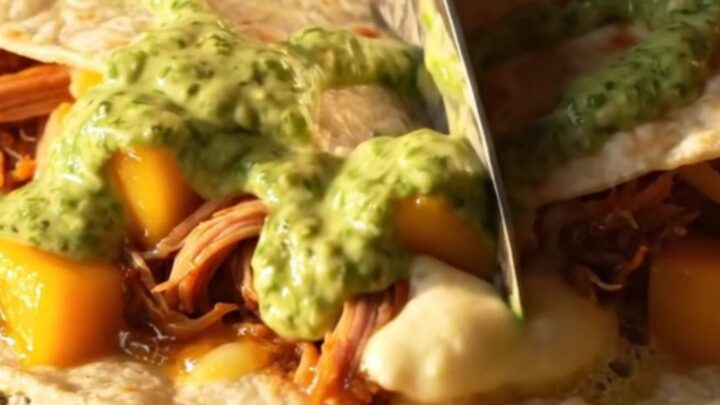
- Drizzle, slice and serveDrizzle cilantro-lime crema in thin lines across the top of the rested quesadilla. With a sharp chef's knife, cut it into three or four crisp wedges, wiping the blade between cuts. Serve immediately while the tortilla still crackles and the first pull of cheese stretches from wedge to wedge.Look for Wedges hold their shape, steam rising from the sweet-spicy filling, crema pooling lightly on the board.Tip Cut with a pressing motion rather than sawing so the crust shatters cleanly instead of cracking the filling out.
The finished quesadilla rests two minutes, until the cheese at the seam looks glossy and thick and no longer flows when the edge is nudged. The crema drizzle should sit in fine lines on the crisp surface, sinking slightly where the tortilla is hottest. Cut into three or four wedges with a sharp knife using a pressing motion, wiping the blade between cuts.
Common mistakes
The most common failure is an overloaded tortilla: more than the listed filling tears the fold and spills on the griddle, so measure rather than eyeball.
Cold pork is the second culprit; it drops the pan temperature and leaves the cheese grainy while the tortilla already darkens, so always warm and drain the pork first. Over-high heat blisters the tortilla before the cheese melts; if the butter browns within seconds, pull the pan off the heat and restart at medium.
How to tell it’s done
The quesadilla is done when both sides are deep golden and blistered in scattered patches, the cheese is visibly molten at the open seam, and the filling feels hot all the way to the center of the fold.
The pork component must have been reheated to 145°F (63°C) on an instant-read thermometer before layering, with a 3-minute rest, so it is heated through safely. Press the surface gently with the spatula: it should feel springy and warm everywhere, with no cool spots near the seam.
- Steaks, chops and roasts: 145°F (63°C) in the thickest part, then a 3-minute rest
Up next · Part 3 of 3
4 variations · storage & make-ahead · 5 answers · printable card
Tips, FAQ & printable recipe (Part 3)← Back to the ingredients (Part 1)