Dinner · Part 2 of 3: Instructions
Cheesy Taco Spaghetti Casserole Step-by-step instructions
- Prep
- Cook
- Total
- Serves
- 6
Before you start
Before beginning, gather and measure all ingredients to ensure a smooth cooking process. Bring a large pot of salted water to a rolling boil for the spaghetti. Chop any fresh herbs for the garnish, grate the cheddar cheese from a fresh block, and preheat the oven to 375°F (190°C) so it is ready to bake as soon as the casserole is assembled.
Ingredients at a glance (6)
- 8 oz spaghetti
- 1 lb ground beef
- 1 packet taco seasoning
- 4 oz cream cheese
- 2 cups shredded cheddar cheese
- 2 tbsp finely minced herbs, for garnish
Instructions
Boiling the Pasta and Browning the Beef
- Boil the SpaghettiCook the spaghetti in a large pot of salted boiling water according to the package instructions until it is al dente. Drain the pasta thoroughly in a colander and set it aside.Look for The pasta should be tender but still retain a slight firmness in the center.Tip Do not overcook the pasta during this step, as it will continue to cook and soften further in the oven.
- Brown the Ground BeefIn a large skillet over medium-high heat, cook the ground beef, breaking it apart with a spatula, until it is completely browned and no pink remains. Drain any excess grease from the skillet.Look for The beef is ready when it is completely browned and has released its fat.Tip Use a lean ratio of ground beef to minimize the grease and keep the casserole light.
At the end of this phase, the spaghetti should be cooked just to al dente, showing a slight bite in the center since it will continue cooking in the oven. The ground beef should be completely browned with no pink remaining, releasing a savory, rich aroma. The excess grease should be fully drained to keep the final casserole light and clean.
Creating the Creamy Taco Sauce
- Build the Creamy Taco SauceReduce the heat to medium. Stir the taco seasoning and cream cheese into the skillet with the beef. Stir constantly until the cream cheese is fully melted and the sauce is smooth, ensuring the ground beef reaches a safe internal temperature of 160°F (71°C).Look for The cream cheese should be fully dissolved, creating a uniform, creamy pinkish-orange sauce.Safe temperature 160°F (71°C) internal temperature (ground meat)Tip Cut the cream cheese into small cubes beforehand so it melts much faster and more evenly.
- Combine Pasta and SauceAdd the drained spaghetti directly into the skillet with the creamy taco meat sauce. Fold the pasta gently using a spatula until every strand of spaghetti is thoroughly coated in the sauce.Look for The spaghetti should be evenly distributed and completely covered by the creamy sauce.Tip Work quickly while the sauce is still warm to make folding the pasta easier and prevent clumping.
The sauce should look smooth, glossy, and thick, with the cream cheese fully integrated into the beef and taco seasoning.
The ground beef should be completely coated in the velvety, pinkish-orange sauce, smelling strongly of cumin, chili powder, and garlic. The spaghetti should be evenly folded in, with every strand glistening with the creamy mixture.
Baking to Golden Perfection
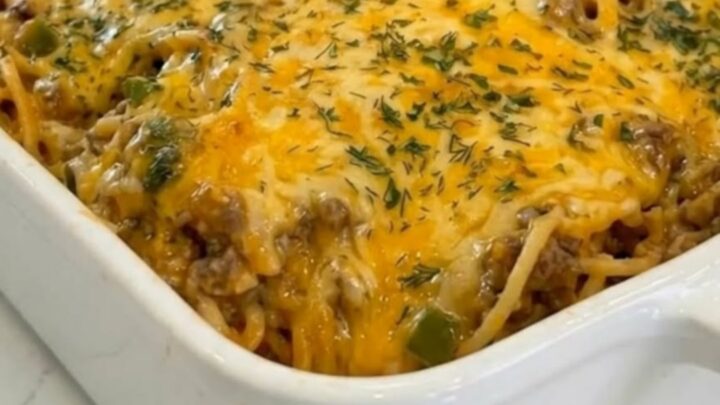
- Assemble and BakeTransfer the creamy pasta mixture into a greased 9x13-inch baking dish, spreading it into an even layer. Blanket the entire top of the spaghetti evenly with the shredded cheddar cheese. Bake at 375°F (190°C) for 15 to 20 minutes.Look for The cheese on top should be completely melted, bubbling, and showing light golden-brown toasted spots.Tip Grate the cheddar cheese from a fresh block for the smoothest, most luxurious melt.
- Garnish and RestRemove the casserole from the oven and let it rest for 5 minutes. Sprinkle the finely minced herbs over the hot, melted cheese before slicing and serving.Look for The casserole should stop bubbling vigorously and set slightly during the resting period.Tip Resting the casserole is crucial because it allows the creamy sauce to thicken, making it much easier to slice.
The casserole is ready when the cheddar cheese on top is completely melted, bubbling vigorously around the edges, and showing beautiful golden-brown spots.
A spatula inserted into the center should release a puff of steam, and lifting a portion should reveal long, molten cheese pulls. The kitchen will fill with a rich, toasted cheese and warm spice aroma.
Common mistakes
One common mistake is overcooking the spaghetti during the initial boil. Because the pasta undergoes a second cooking phase in the oven, boiling it past the al dente stage will result in mushy, soft noodles.
Another error is failing to drain the ground beef thoroughly after browning, which leads to a greasy pool at the bottom of the baking dish. Lastly, baking the casserole uncovered for too long can dry out the sauce.
How to tell it’s done
Doneness is determined by both the visual state of the cheese and the internal temperature of the meat. The cheddar cheese on top must be fully melted, bubbling, and lightly browned.
Crucially, the seasoned ground beef mixture must reach a safe internal temperature of 160°F (71°C) before serving. Let the casserole rest for five minutes after baking to allow the sauce to set slightly, making it easier to slice.
- Ground meat: 160°F (71°C) in the thickest part
Up next · Part 3 of 3
3 variations · storage & make-ahead · 3 answers · printable card
Tips, FAQ & printable recipe (Part 3)← Back to the ingredients (Part 1)