Dinner · Part 2 of 3: Instructions
Cheesy Baked Eggplant Lasagna: A Comforting Dinner Step-by-step instructions
- Prep
- Cook
- Total
- Serves
- 6
Before you start
Before beginning, ensure all ingredients are ready for assembly. Have a sharp knife and a large cutting board ready for slicing the eggplants uniformly. Preheat the oven to 375°F (190°C) well in advance, and prepare your baking dish by lightly greasing it if necessary.
Clear sufficient counter space for assembling the layers, and keep the ingredients organized so you can build the lasagna efficiently without any interruptions during the process.
Ingredients at a glance (4)
- 2 large eggplants, sliced into 1/4-inch rounds
- 24 oz marinara or tomato sauce
- 15 oz whole milk ricotta cheese
- 16 oz shredded mozzarella cheese
Instructions
Preparation of the eggplant
- Prepare the eggplantSlice the eggplants into thin, even rounds using a sharp knife. Ensure the slices are uniform in thickness to promote consistent cooking throughout the baking process.Look for The eggplant slices should be cut into consistent rounds.Tip Use a sharp chef's knife to ensure clean cuts through the eggplant skin.
At the end of this phase, the eggplant slices should be uniformly cut and ready for assembly. Ensure that all slices are of similar thickness to guarantee even cooking.
This is the most critical checkpoint for achieving the desired final texture of the lasagna, as uniform slices will ensure that the eggplant softens perfectly alongside the sauce and cheese during the baking process.
Assembling the layers
- Assemble the layersSpread a thin layer of tomato sauce at the bottom of a 9x13 inch baking dish. Arrange a layer of eggplant slices over the sauce, followed by a layer of ricotta cheese and a sprinkle of shredded mozzarella. Repeat these layers until all ingredients are used, finishing with a generous layer of mozzarella.Look for The dish should be filled to the brim with alternating layers of sauce, eggplant, and cheese.Tip Ensure the ricotta is spread evenly to provide a creamy consistency in every bite.
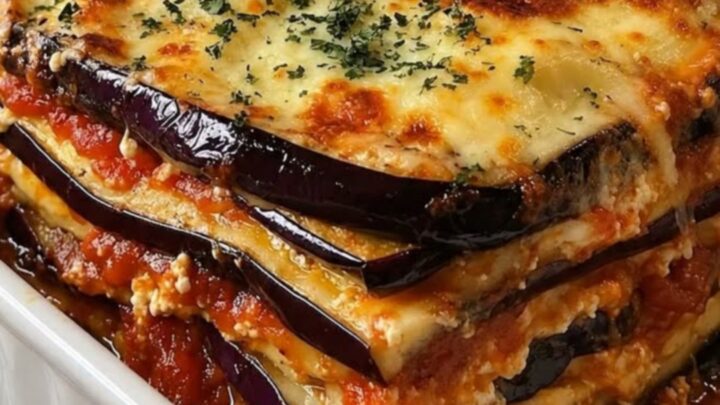
The assembly is complete when the baking dish is filled with distinct, alternating layers of sauce, eggplant, and cheese. Check that the edges are neat and that the final layer of mozzarella covers the top completely. The dish should look uniform, with the ingredients distributed evenly to ensure that every portion served contains a balanced amount of each component.
Baking and final rest
- Bake and serveCover the dish with foil and bake at 375°F (190°C) for 30 minutes. Remove the foil and bake for another 15 minutes until the cheese is bubbling and golden brown. Let the lasagna rest for 10 minutes before slicing and serving to allow the layers to set.Look for The cheese should be melted and golden brown, with the sauce bubbling around the edges.Tip Allowing the lasagna to rest is essential for clean slices.
The lasagna is finished when the cheese is golden brown and the sauce is bubbling around the perimeter. After removing it from the oven, the most important checkpoint is the mandatory 10-minute resting period. This time allows the internal temperature to stabilize and the layers to set, ensuring that when you slice the lasagna, it holds its shape perfectly on the plate.
Common mistakes
Avoid slicing the eggplant too thick, which prevents it from cooking through properly, leaving the texture tough. Ensure you do not over-crowd the layers, as this can lead to uneven cooking.
Finally, do not rush the resting period; cutting into the lasagna immediately after removing it from the oven will cause the layers to slide apart, ruining the presentation of the dish.
How to tell it’s done
The lasagna is done when the internal temperature is thoroughly heated through and the cheese on top is beautifully browned and bubbling. You can verify this by inserting a knife into the center to ensure the eggplant is tender and the layers have fused together.
The edges of the dish should show the sauce bubbling actively, indicating that the heat has permeated the entire assembly, ensuring a hot and delicious meal.
Up next · Part 3 of 3
2 variations · storage & make-ahead · 3 answers · printable card
Tips, FAQ & printable recipe (Part 3)← Back to the ingredients (Part 1)