Desserts · Part 2 of 3: Instructions
Cast-Iron S’mores Skillet Brownie with Toasted Marshmallow Meringue Step-by-step instructions
- Prep
- Cook
- Total
- Serves
- 8
Before you start
Before starting, gather all ingredients and equipment. Preheat the oven to 350°F (175°C).
Prepare the graham cracker crust by mixing crumbs with melted butter. Have the brownie batter ready, either homemade or from a mix.
Make the Swiss meringue in advance or just before assembling, ensuring it is thick and glossy. Set up a workspace with the skillet, torch, and spatula within reach.
Ingredients at a glance (5)
- 1 1/2 cups graham cracker crumbs
- 6 tbsp unsalted butter, melted
- 1 batch dark chocolate brownie batter (homemade or store-bought)
- 4 oz milk chocolate bars, broken into pieces
- 1 batch Swiss meringue (egg whites and sugar, whipped)
Instructions
Building the Base
- Prepare the Crust and BatterHeat the oven to 350°F (175°C). In a small bowl, mix the graham cracker crumbs with the melted butter until evenly moistened. Press the mixture firmly into the bottom and up the sides of a 10-inch cast-iron skillet. Set aside.Look for The crust should hold together when pressed; no dry crumbs remain.Tip Use the bottom of a measuring cup to press the crust evenly for a compact base.
- Add the Brownie BatterPrepare the brownie batter according to the recipe or package instructions. Pour the batter over the prepared crust, spreading it evenly. Scatter the milk chocolate pieces over the top, gently pressing them into the batter.Look for The batter should be level and the chocolate pieces partially submerged.Tip If using homemade batter, avoid overmixing to keep the brownies fudgy.
The crust should be evenly pressed and hold together, with a buttery aroma. The brownie batter is poured and smoothed, with chocolate pieces visible on top. The skillet is ready for the oven.
Baking to Fudgy Perfection
- Bake the BrowniePlace the skillet in the oven and bake for 22 minutes, or until the edges are set and the center is just moist but not wet. A toothpick inserted into the center should come out with a few moist crumbs.Look for The top looks shiny and slightly cracked; the center is tender but not jiggly.Safe temperature 160°F (71°C) internal temperature (egg dishes)Tip Start checking at 20 minutes; ovens vary, and the brownie will continue to set as it cools.
- Cool SlightlyRemove the skillet from the oven and let it cool on a wire rack for 10 minutes. The brownie should be warm but not piping hot, so the meringue can be added without melting completely.Look for The skillet is warm to the touch, and the brownie has pulled away slightly from the edges.Tip Cooling briefly helps the meringue hold its shape when torched.
The brownie is baked for 22 minutes, with a shiny top and slightly cracked edges. The center is moist but not wet, and the kitchen smells of rich chocolate. The skillet is warm and ready for the meringue.
Torching the Meringue
- Top with MeringueSpoon the Swiss meringue over the warm brownie, creating swoops and peaks with the back of a spoon or a spatula. Make sure the meringue covers the entire top surface to the edges.Look for The meringue forms tall, fluffy peaks that hold their shape.Tip For dramatic peaks, use the back of a spoon to pull upward and create swirls.
- Torch the MeringueUsing a kitchen torch, carefully toast the meringue until it is golden brown and charred in spots. Move the torch in a circular motion, keeping it about 2 inches from the surface to avoid burning.Look for The meringue turns a deep golden brown with darker caramelized areas.Safe temperature 160°F (71°C) internal temperature (egg dishes)Tip Keep the torch moving to achieve even browning without scorching.
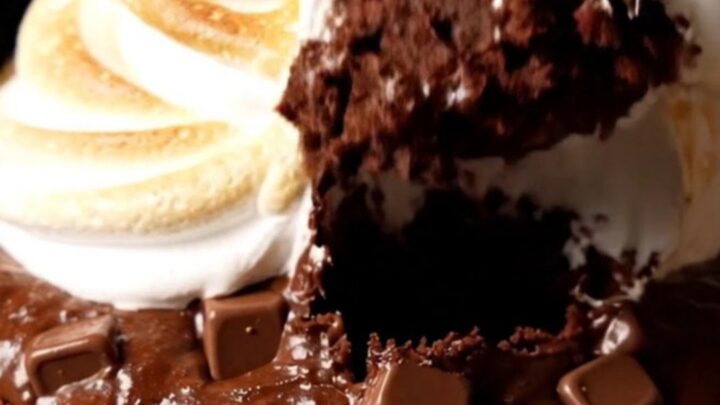
The meringue is piled high with dramatic peaks, then torched to a golden brown with charred spots. The topping is crisp on the outside and soft inside, with a smoky, toasted aroma.
Common mistakes
Avoid overbaking the brownie, as it will become dry and cakey. Check for doneness at the 20-minute mark. Do not skip cooling the brownie before adding the meringue, or the meringue may melt and slide off.
When torching, keep the flame moving to prevent burning. If the meringue starts to brown too quickly, lower the torch or move it farther away.
How to tell it’s done
The brownie is done when the edges are set and the center is moist but not jiggly. A toothpick inserted into the center should come out with a few moist crumbs, not wet batter.
The internal temperature of the brownie should reach at least 160°F (71°C) to ensure the eggs are fully cooked. The meringue should be golden brown and crisp on the outside, with a soft, marshmallow-like interior.
- Egg dishes: 160°F (71°C) in the thickest part
Up next · Part 3 of 3
4 variations · storage & make-ahead · 5 answers · printable card
Tips, FAQ & printable recipe (Part 3)← Back to the ingredients (Part 1)