Desserts · Part 2 of 3: Instructions
Caramel Apple Turnovers with Flaky Puff Pastry Step-by-step instructions
- Prep
- Cook
- Total
- Serves
- 6
Before you start
Gather everything before you start, because the pastry needs to stay cold while you fill it. Thaw the puff pastry in the refrigerator, then unroll it on a lightly floured board only when you are ready to cut. Peel and dice the red apple into small uniform cubes and toss them with brown sugar so the sugar starts to draw out a little juice.
Keep the caramel block in the refrigerator until the moment you grate it. Beat the egg with a teaspoon of water for the wash, and set the parchment-lined baking sheet, fork, pastry brush and sharp knife within reach. Heat the oven to 400°F (200°C) and set a rack in the middle so the turnovers bake evenly. Warm the caramel sauce gently just before plating.
Ingredients at a glance (7)
- 1 sheet puff pastry, store-bought or made ahead, thawed
- 1 red apple, peeled and diced small
- 2 tbsp brown sugar
- 2 oz firm caramel candy, cold, for grating
- 1 egg, beaten with 1 tsp water, for egg wash
- 1/2 cup caramel sauce, store-bought or made ahead, warm
- flaky sea salt for serving
Instructions
Filling and pastry ready
- Prepare the apple fillingPeel the red apple, cut it into small uniform cubes, and toss them with the brown sugar on a wooden board. Set the mixture aside while you prepare the pastry and the caramel.Look for Cubes should be small and even, roughly the size of a pea, with the sugar clinging to them.Tip Uniform cubes cook at the same rate, so no piece stays firm while another turns mushy.
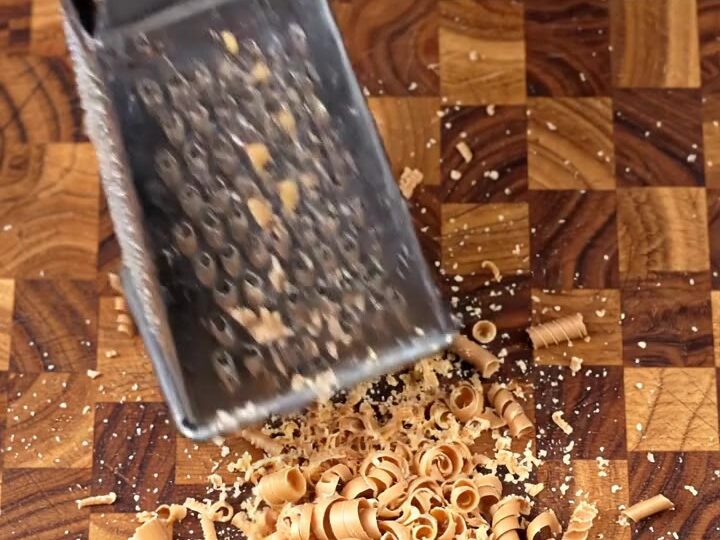
- Grate the caramelHeat the oven to 400°F (200°C) and line a baking sheet with parchment. Grate the cold caramel on the fine holes of a box grater, letting the thin golden curls fall onto the board.Look for The caramel should form thin, fragile curls that separate easily from the grater.Tip Keep the caramel cold so it grates cleanly instead of smearing on the holes.
- Cut the pastry squaresUnroll the puff pastry on a lightly floured board and cut it into six even squares, about 4 inches each. Lay them out in front of you so each square is ready to fill.Look for Squares should be even and cold, with clean edges that have not started to soften.Tip Work quickly so the pastry stays cold and layers puff cleanly in the oven.
Your apple should be diced into small, even cubes with a light coating of brown sugar, and the caramel should be grated into thin golden curls that fall loosely onto the board. The puff pastry should be cut into six even squares and still feel cold and firm to the touch, with no soft spots or sticky surfaces.
Check that the grated caramel is not clumping and that the apple cubes are not swimming in juice, since too much liquid will make the filling leak. Once the squares are cut and the filling is ready, move quickly to the folding step so the pastry stays cold and layers stay distinct when baked. If the squares start to soften, return them to the refrigerator for a few minutes before filling and folding.
Turnovers folded and sealed
- Fill and fold the turnoversPlace a spoonful of the diced apple mixture in the center of each square, then scatter a few grated caramel curls over the apple. Fold each square into a triangle and press the edges closed with a fork.Look for The edges should be sealed firmly, with the fork marks clearly visible on each turnover.Tip Leave a small border of pastry so the filling stays inside while baking.
- Arrange and egg washArrange the turnovers in neat rows on the parchment-lined sheet, leaving space between them. Brush each one lightly with the egg wash, then cut a small vent in the top of each turnover.Look for The tops should look glossy and even, with no bare patches of pastry.Tip Use a light hand with the egg wash so it does not pool at the edges and block the layers.
- Bake until deep goldenBake the turnovers on the middle rack for 22 to 25 minutes, until the pastry is puffed and deep golden and the filling bubbles at the vents. Let them rest on the sheet for 10 minutes before serving.Look for Pastry should be puffed, deep golden and crisp, with caramel bubbling through the vents.Safe temperature 160°F (71°C) internal temperature (egg dishes)Tip If the bottoms brown too fast, slide the sheet to a lower rack for the last few minutes.
Each turnover should be a neat triangle with a firmly crimped edge, sealed all the way along the sides with clear fork marks. The filling should sit in the center with a small border of pastry around it, and a few caramel curls should be visible among the apple cubes. Look at each one before moving on: any open seams will let caramel escape and burn on the sheet.
Arrange the turnovers in rows on the parchment with space between them, then brush the tops evenly with egg wash and cut a small vent in each one. The tops should look glossy and smooth, with no bare patches. If a seam has opened, press it closed again before baking so the filling stays inside while the pastry puffs around it.
Baked and resting
- Plate and finishTransfer the warm turnovers to the wooden board. Drizzle the warm caramel sauce over the top so it runs down the sides, then sprinkle each pastry with a light pinch of flaky sea salt.Look for The sauce should be glossy and pourable, running down the sides of each turnover.Tip Warm the caramel sauce gently so it flows without thinning too much.
- Serve the warm turnoversServe the turnovers while still warm, with any extra caramel sauce on the side. Eat them soon after baking, while the pastry is still crisp and the filling is glossy.Look for Pastry should still crackle lightly and the filling should look glossy and soft.Tip Serve on the board so guests can see the drizzle and salt on each piece.
The baked turnovers should be puffed high, with a deep golden color on top and sides, and the sugar should be bubbling slightly through the vents. The pastry should sound crisp when you tap it lightly and smell of butter and toasted sugar. Check that the bottoms are golden and not pale, since a pale base means the pastry has not finished baking.
Let them rest on the sheet for 10 minutes so the filling sets slightly and does not run when you cut into them. Before plating, confirm the centers are hot and the caramel is fully melted, since underbaked filling will taste gritty and the pastry will soften quickly as it cools.
Common mistakes
Avoid crowding the pan or flipping too early before a crust forms, keep the burner at steady medium-high heat so aromatics never scorch, and season in balanced layers rather than only at the end.
How to tell it’s done
The dish is ready when the exterior shows even golden color, the center feels tender when pressed gently with a fork, and the sauce coats the back of a spoon glossy and fragrant.
- Egg dishes: 160°F (71°C) in the thickest part
Up next · Part 3 of 3
4 variations · storage & make-ahead · 5 answers · printable card
Tips, FAQ & printable recipe (Part 3)← Back to the ingredients (Part 1)