Breakfast · Part 3 of 3: Tips & recipe card
Biscuit Sandwich with Sausage Gravy and a Jammy Egg Tips, FAQ & printable recipe
- Prep
- Cook
- Total
- Serves
- 1
Tips for success
Crack the black pepper coarse for the gravy — visible flecks are part of the look and the flavor arrives in slow waves rather than one sharp hit.
Brown the sausage harder than feels right: those dark crumbles season the entire gravy through the drippings, and pale sausage cannot be fixed later. If the gravy sits while the egg cooks, keep it on the lowest heat and stir once; it will loosen with a splash of milk when ladled.
Work in the order of a short-order cook: gravy first because it holds, biscuit second because it stays warm, patty and egg last because they need to hit the stack hot. Assemble on the serving plate, never on a board.
Warm the fork and knife under hot tap water for ten seconds — a small touch that keeps the first bite as hot as the last. Scale by repeating, not by doubling the pans.
Variations
- Extra-pepper gravy: Double the cracked black pepper and add a pinch of cayenne with the milk. The gravy turns sinus-clearing and deeply savory — the classic firehouse style that stands up to the rich biscuit and cheese.
- Scrambled-egg stack: Replace the fried egg with soft-scrambled eggs cooked low and slow, pulled while still glossy. They spread evenly through the layers instead of pooling, and every bite carries a little egg.
- Open-face biscuit: Skip the biscuit top and ladle the gravy generously over the stacked patty, cheddar and egg on the bottom half alone. Easier to cut, and the gravy-to-biscuit ratio climbs dramatically.
- Maple-drizzle finish: Add a thin thread of pure maple syrup over the assembled stack just before serving. The sweetness against the pepper gravy and sausage is a classic Southern counterpoint that divides tables and delights half of them.
Storage and make-ahead
- Fridge
- Gravy and patty keep 2 days in a covered container; the biscuit, wrapped separately, holds 1 day before it loses its edge.
- Freezer
- Freeze the gravy up to 1 month in a sealed container; thaw overnight in the refrigerator and reheat slowly with a splash of milk.
- Reheat
- Reheat gravy over low heat with a little milk, whisking; rewarm the patty covered in a skillet and the biscuit in a 350°F (175°C) oven for 5 minutes.
Cool any leftover gravy and patty to room temperature for no more than 2 hours, then refrigerate in a covered container. Store the biscuit separately, wrapped, so it keeps its edge. The assembled sandwich does not hold well — the biscuit absorbs the gravy — so keep components apart and rebuild warm. Eat within 2 days for the best texture and flavor.
The gravy is the make-ahead workhorse: it can be made up to 2 days ahead, cooled, and refrigerated in a jar. Reheat it over low heat, whisking, with a tablespoon or two of milk to bring back its pourable consistency.
Biscuits bake beautifully a day ahead and rewarm in a 350°F (175°C) oven for 5 minutes. Cook the patty ahead too, then warm it through in the skillet; fry the egg and build the stack fresh.
Serving ideas
Serve the sandwich on a warm plate with a knife and fork, and a napkin close by — the yolk and the gravy meet at the first cut and travel. A single extra ladle of hot gravy on the side of the plate turns every broken-off biscuit corner into a scoop. cracked pepper over the top at the table keeps the heat bright.
This is a one-plate meal by design, but it sits well beside simple partners: sliced ripe tomatoes with a pinch of salt, a handful of crisp hash browns, or fresh fruit for contrast.
Coffee is the classic pour; strong black tea works too. For a second sandwich, repeat the skillet sequence rather than doubling quantities in one pan — the gravy needs room to simmer evenly.
Frequently asked questions
Can the gravy be made ahead of time?
How is the egg cooked through for someone who prefers it that way?
Why is the gravy too thin or too thick, and how is it fixed?
Can a different cheese be used instead of cheddar?
What kind of biscuit works best for this sandwich?
Biscuit Sandwich with Sausage Gravy and a Jammy Egg
Ingredients
- 5 oz ground pork breakfast sausage, crumbled
- 2 1/2 tbsp all-purpose flour
- 3/4 cup whole milk
- 1 tsp cracked black pepper, plus more to taste
- 1 large 6-layer buttermilk biscuit, warm, store-bought or made ahead
- 1 ground pork sausage patty
- 1 slice cheddar cheese
- 1 large egg
Instructions
- Set a 10-inch cast-iron skillet over medium-high heat and let it warm for a minute. Add the breakfast sausage and break it up with a wooden spoon into small crumbles. Cook, stirring occasionally, for 5 to 6 minutes, until the pieces are deeply browned with no pink left and the fat has rendered into the pan.
- Keep the heat at medium and sprinkle the flour evenly over the sausage and its drippings. Stir constantly with the wooden spoon for about 1 minute, scraping the browned bits from the bottom of the skillet. The flour should coat every crumble and turn from dusty white to a faint sandy gold.
- Pour in the whole milk while whisking steadily, lifting the browned bits off the bottom so nothing sticks. Add the cracked black pepper. Keep whisking as the gravy comes to a gentle bubble, then drop the heat to medium-low so it holds a lazy simmer. The base should already look slightly thickened at the edges.
- Let the gravy simmer gently for 3 minutes, stirring every 30 seconds or so with the whisk so the bottom never catches. It is ready when it coats the back of the spoon thickly and settles slowly back into itself. Taste and adjust the black pepper — it should carry a definite kick.
- While the gravy simmers, warm the buttermilk biscuit — a 350°F (175°C) oven for about 5 minutes, or a minute in a dry skillet, brings back its crisp edge. Set it on a board and split it horizontally into top and bottom halves with a serrated sawing motion, keeping the layers intact. Arrange both halves cut side up.
- Set a small nonstick skillet over medium heat and cook the sausage patty for about 3 minutes per side, pressing it lightly with the spatula, until browned on both faces and cooked through to 160°F (71°C) at the center. Move it to a plate and lay the cheddar slice on top so the residual heat begins to soften the cheese.
- Return the same nonstick skillet to medium-low heat and crack in the egg. Cook for 2 to 3 minutes until the white is fully set and the edges turn lacy and crisp, leaving the yolk warm and creamy. For a fully cooked yolk, cover the pan and continue until it reaches 160°F (71°C). Slide the egg onto a plate without breaking it.
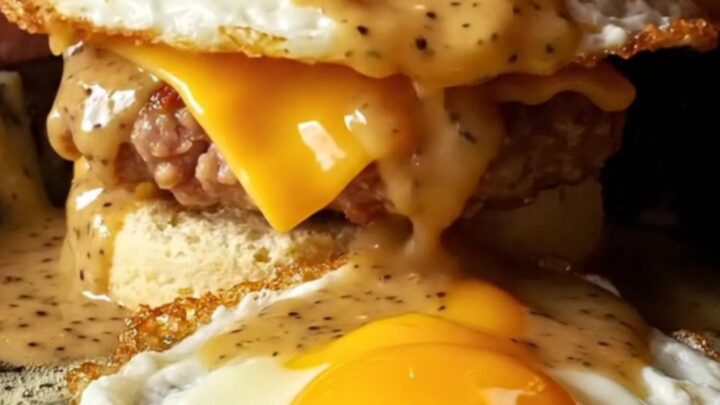
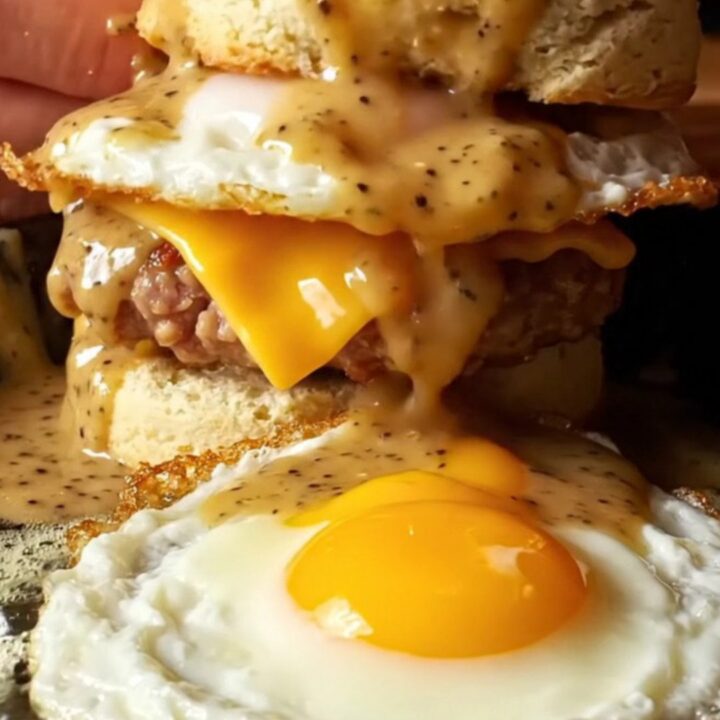
- Set the biscuit bottom on a warm plate. Lay the cheddar-topped sausage patty on it, then slide the fried egg over the cheese. Ladle a generous spoonful of sausage gravy around and over the egg so it runs into the layers, then crown the stack with the biscuit top and one more ladle of gravy.
- Give the whole sandwich one final grind of cracked black pepper and carry it to the table while the biscuit still steams and the gravy is hot. Serve with a knife and fork and a napkin within reach — the yolk and the gravy meet at the first cut, and that is the point of the whole build.
Estimated nutrition per serving
- Calories
- 1050
- Protein
- 38 g
- Carbohydrates
- 62 g
- Fat
- 68 g
Next recipe

Crispy Hashbrown Birria Tacos with a Runny Fried Egg
See the recipe → →This recipe is based on a short cooking video and is published under the pen name Clara Weller. It was checked before publication, but errors can slip through. Nutrition, when shown, is an estimate. Read more in our editorial policy and on our food safety page.
More recipes to try

Viral Four-Quadrant Breakfast Tortilla Fold — Crispy, Cheesy, 15 Minutes
Total time: 20 min
Slow-Cooker French Toast Casserole, Ready When You Are
Total time: 4 h 25 min
Tortilla-Crust Chorizo Quiche — No Pie Crust Needed
Total time: 35 min
Hash Brown Patty Breakfast Casserole with Turkey Sausage
Total time: 1 h 15 min
Philly Cheesesteak Breakfast Strata with Cheddar Sauce
Total time: 1 h 10 min