Dinner · Part 2 of 3: Instructions
Authentic Turkish Lahmacun: Thin Crispy Spiced Lamb Flatbread Step-by-step instructions
- Prep
- Cook
- Total
- Serves
- 4
Before you start
Before starting, make sure the pizza stone is in the oven and preheating — it needs at least 30 minutes to reach full temperature. Measure all ingredients. The dough can be made and rested while the oven heats. Have a pizza peel or a rimless baking sheet ready for transferring the flatbreads.
Prepare the toppings by washing and roughly chopping the vegetables and herbs. Keep the lamb chilled until ready to mix. The dough will be easier to roll if it rests for at least 30 minutes, so plan accordingly.
Ingredients at a glance (15)
- 300 g bread flour
- 180 ml water
- 1 tsp salt
- 300 g ground lamb (20% fat)
- 1 finely minced onion
- 1 red bell pepper
- 1 ripe tomato
- 2 cloves garlic
- 1 tbsp tomato paste
- 1 tbsp pepper paste
- 1/4 bunch fresh parsley
- 1 tsp ground cumin
- 1 tsp Urfa isot flakes
- fresh mint leaves, for serving
- lemon wedges, for serving
Instructions
Prepare the Dough and Topping
- Make the DoughIn a large bowl, combine the bread flour and salt. Add the water and mix with a spoon until a shaggy dough forms. Turn onto a clean surface and knead for 5 to 7 minutes until smooth and elastic. The dough should be soft but not sticky; if too sticky, add a little flour. Cover with a damp towel and let rest for 30 minutes.Look for The dough is smooth, springs back when pressed, and no longer sticks to the work surface.Tip A slightly wetter dough yields a thinner, crispier flatbread. Resist adding too much flour.
- Pulse the VegetablesIn a food processor, combine the onion, red bell pepper, tomato, garlic, and parsley. Pulse until finely minced but not pureed; you want a textured paste. Transfer to a large bowl.Look for The mixture looks like a coarse relish with tiny bits of vegetables, not a smooth puree.Tip Squeeze out excess moisture from the tomato and pepper with your hands if the mixture seems watery.
- Mix the Lamb ToppingAdd the ground lamb, tomato paste, pepper paste, cumin, and Urfa isot flakes to the vegetable mixture. Use your hands to combine thoroughly, mashing and kneading until the mixture is homogenous and slightly sticky. Cover and refrigerate while the dough rests.Look for The topping is a uniform reddish paste with no streaks of raw lamb.Tip Chilling the topping makes it easier to spread thinly over the dough.
By the end of this phase, the dough is smooth, elastic, and rested for 30 minutes. The topping is a uniform, slightly sticky paste with finely minced vegetables and aromatic spices.
The lamb is well incorporated, and the mixture smells of cumin and Urfa isot. The oven should be preheating with the stone inside. Everything is ready for rolling and baking.
Roll, Top, and Bake
- Preheat the StonePlace a pizza stone on the middle rack of the oven. Preheat the oven to 500°F (260°C) for at least 30 minutes so the stone is thoroughly hot.Look for The stone is screaming hot; a drop of water sizzles instantly.Tip If no pizza stone, use an inverted baking sheet; preheat it too.
- Divide and Roll the DoughDivide the rested dough into 4 equal pieces. On a lightly floured surface, roll one piece into an ultra-thin round, about 10 to 12 inches in diameter. The dough should be almost translucent, thin enough to see your hand through.Look for The dough is paper-thin, about 1/16 inch thick, with no tears.Tip Keep the other pieces covered with a towel while rolling to prevent drying.
- Spread the ToppingSpread a thin, even layer of the lamb topping over the rolled dough, going all the way to the edges. Use a spatula or the back of a spoon to spread it thinly; you should see the dough through the topping in places.Look for The topping covers the entire surface in a thin, even layer, leaving no bare spots.Tip If the topping sticks to the spatula, dip it in water occasionally.
- Bake the LahmacunTransfer the topped flatbread to a pizza peel dusted with flour. Slide it onto the hot stone and bake for 4 minutes, until the bottom is leopard-spotted and the edges are shatteringly crisp. The topping should be cooked through and the lamb reaches 160°F (71°C).Look for The edges are deeply blistered and charred in spots; the bottom is golden with dark leopard spots.Safe temperature 160°F (71°C) internal temperature (ground meat)Tip If the topping browns too quickly, move the flatbread to a higher rack for the last minute.
- Bake the Remaining FlatbreadsRemove the baked lahmacun to a wire rack. Repeat the rolling, topping, and baking with the remaining dough pieces. Keep the baked flatbreads warm by stacking them on a plate and covering loosely with foil.Look for Each flatbread is crisp and slightly curled at the edges.Safe temperature 160°F (71°C) internal temperature (ground meat)Tip Do not stack hot flatbreads directly on each other; they will steam and lose crispness.
The flatbreads are rolled paper-thin and topped evenly. As each one bakes, the kitchen fills with the smell of toasting lamb and charred dough. The edges blister and crisp, and the bottom develops leopard spots. The lamb is cooked through and reaches 160°F (71°C). The flatbreads are crisp but pliable, and they cool on a wire rack.
Garnish and Serve
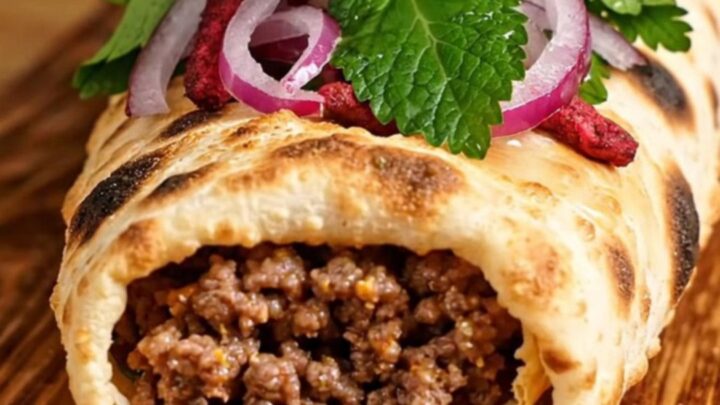
- Garnish and RollTo serve, place a lahmacun on a plate. Pile fresh parsley and mint leaves down the center, add a few lemon wedges on the side, and squeeze fresh lemon juice over the top. Roll the flatbread into a tight cylinder and eat with your hands.Look for The rolled flatbread is tight, with herbs peeking out at the ends.Tip Serve immediately while crisp; the flatbread softens as it sits.
The lahmacun is piled with fresh parsley and mint, and a generous squeeze of lemon brightens the top. When rolled, it forms a tight cylinder that fits perfectly in one hand. The first bite yields a satisfying crunch, followed by the juicy, spiced lamb and the herbal freshness. Serve immediately while still crisp.
Common mistakes
One common mistake is rolling the dough too thick, which results in a chewy, bread-like crust instead of a crisp one. Use a thin rolling pin and apply even pressure, rotating the dough as you go.
Another issue is a soggy topping — if the vegetables release too much water, the flatbread will steam rather than crisp. Squeeze out excess moisture from the tomato and pepper before mixing, and spread the topping thinly. Finally, don't overload the stone; bake one at a time to maintain high heat.
How to tell it’s done
The lahmacun is done when the edges are deeply blistered and the bottom is golden with dark leopard spots from the stone. The topping should be cooked through and slightly charred in places, and the lamb must reach an internal temperature of 160°F (71°C).
The flatbread should be crisp enough to crackle when you fold it, but still pliable enough to roll without breaking. If the edges are browning too fast, move the flatbread to a higher rack for the last minute.
- Ground meat: 160°F (71°C) in the thickest part
Up next · Part 3 of 3
4 variations · storage & make-ahead · 5 answers · printable card
Tips, FAQ & printable recipe (Part 3)← Back to the ingredients (Part 1)