Desserts · Part 2 of 3: Instructions
Crispy Sicilian Ricotta Cannoli: Make Them at Home Step-by-step instructions
- Prep
- Cook
- Total
- Serves
- 12
Before you start
Before starting, make sure all ingredients are at room temperature. Drain the ricotta in a fine-mesh strainer lined with cheesecloth for at least 2 hours, or overnight, to remove excess liquid. Set up your workstation with a rolling pin, round cutter, cannoli tubes, and a baking sheet.
Heat the oil in a heavy pot and have a deep-frying thermometer ready. Prepare a wire rack for draining the fried shells. Have the crushed pistachios ready for garnishing. The dough needs a 30-minute rest, so plan accordingly.
Ingredients at a glance (12)
- 500 g drained sheep's milk ricotta
- 130 g icing sugar
- 1/2 tsp ground cinnamon
- 1/2 cup dark chocolate chips
- 2 cups all-purpose flour
- 1 tbsp unsweetened cocoa powder
- 2 tbsp granulated sugar
- 1/4 tsp salt
- 1/2 cup Marsala wine
- 1 large egg
- 4 cups vegetable oil, for frying
- 1/2 cup crushed Bronte pistachios
Instructions
Preparing the Dough
- Make the Pastry DoughIn a large bowl, whisk together the flour, cocoa powder, sugar, and salt. Make a well in the center and add the Marsala wine and the egg. Use a fork to gradually incorporate the flour into the liquid until a shaggy dough forms. Turn the dough out onto a lightly floured surface and knead for about 5 minutes until smooth and elastic. Wrap the dough in plastic wrap and let it rest at room temperature for 30 minutes.Look for The dough should be smooth and not sticky; if it feels dry, add a teaspoon of wine at a time.Tip Resting the dough relaxes the gluten, making it easier to roll thin without shrinking.
- Roll and Cut the DoughDivide the dough into two portions. On a lightly floured surface, roll one portion as thin as possible, about 1/16 inch thick. Use a round cutter (about 4 inches in diameter) to cut out circles. Repeat with the remaining dough. Keep the cut circles covered with a clean kitchen towel to prevent drying.Look for The dough should be thin enough to see your hand through it slightly.Tip Use a pasta machine if you have one for even thinner, more consistent sheets.
- Wrap Dough Around TubesPlace a cannoli tube diagonally across one dough circle. Moisten the far edge of the circle with a little water. Wrap the dough around the tube, pressing the moistened edge to seal. Gently press the dough to secure it. Repeat with the remaining circles and tubes, placing the wrapped tubes on a baking sheet.Look for The seam should be firmly sealed to prevent the shell from opening during frying.Tip Do not stretch the dough too tightly; it needs a little room to puff during frying.
After rolling and wrapping the dough around the tubes, the wrapped tubes should look neat and the seams sealed. The dough should be thin enough to be slightly translucent. At this stage, the dough is resting and ready for frying. The oil is heating, and the kitchen is beginning to smell faintly of cocoa and wine. Check that the oil is at the correct temperature before proceeding.
Frying the Shells
- Heat the OilPour the vegetable oil into a heavy pot or Dutch oven, enough to submerge the cannoli shells by at least 2 inches. Heat over medium-high heat until a deep-frying thermometer reads 360°F (182°C). Adjust the heat to maintain this temperature throughout frying.Look for The oil should shimmer and a small piece of dough dropped in should sizzle immediately.Tip Use a thermometer to keep the oil at a steady temperature; too hot and the shells burn, too cool and they absorb oil.
- Fry the ShellsCarefully place a few wrapped cannoli tubes into the hot oil, being careful not to overcrowd. Fry for 90 seconds, turning occasionally with tongs, until the shells are golden brown and covered in blisters. Use tongs to remove the shells and drain on a wire rack. Let cool completely before removing the tubes.Look for The shells should be deep golden brown with a blistered, crackly surface.Safe temperature 160°F (71°C) internal temperature (egg dishes)Tip Fry in batches to keep the oil temperature stable. Cool shells completely before filling.
The shells should emerge from the oil a beautiful deep golden brown, with a blistered, crackly surface. They should feel light and crisp to the touch. The aroma is irresistible—fried pastry with a hint of cocoa. Let them cool completely on a wire rack before gently sliding them off the tubes. If any shells are not fully crisp, they can be returned to the oil for a few more seconds.
Filling and Finishing
- Make the Ricotta FillingIn a mixing bowl, combine the drained sheep's milk ricotta, icing sugar, and ground cinnamon. Beat with an electric mixer on medium speed until smooth and creamy. Gently fold in the dark chocolate chips with a spatula. Transfer the filling to a piping bag fitted with a plain tip.Look for The filling should be thick, smooth, and hold its shape when piped.Tip Ensure the ricotta is well-drained to avoid a runny filling; if too loose, add a tablespoon of powdered sugar.
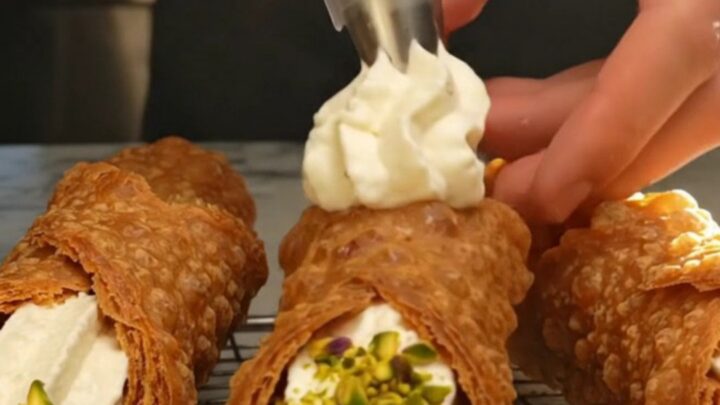
- Fill the CannoliJust before serving, pipe the ricotta filling into each cooled shell from both ends, filling completely. Dip each end of the filled cannoli into the crushed Bronte pistachios. Serve immediately to keep the shells crisp.Look for The shells should be filled to the ends, with pistachios clinging to the filling.Tip Fill only as many as you plan to eat right away; unfilled shells stay crisp for days.
The ricotta filling should be smooth, thick, and creamy, with chocolate chips evenly distributed. When piped into the shells, it should fill them completely, with a little extra peeking out at the ends.
The crushed pistachios add a vibrant green contrast and a pleasant crunch. The finished cannoli look stunning, with the golden shells, white filling, and green pistachios. Serve immediately.
Common mistakes
One common mistake is not draining the ricotta enough, leading to a watery filling that soaks the shells. Another is rolling the dough too thick, which results in a dense, bready shell instead of a light, crisp one.
Overcrowding the fryer can cause the oil temperature to drop, making the shells greasy. Finally, filling the shells too far in advance will cause them to lose their crunch. Always fill only what you plan to eat immediately.
How to tell it’s done
The cannoli shells are done when they are deep golden brown and covered in crispy blisters. The oil should be maintained at 360°F (182°C) throughout frying; if the shells brown too quickly, lower the heat. The filling should be smooth and pipeable, holding its shape without being runny.
When assembled, the cannoli should be filled just before serving to ensure the shells remain crisp. If the shells are not as crisp as desired, they can be re-crisped in a 350°F (175°C) oven for a few minutes before filling.
- Egg dishes: 160°F (71°C) in the thickest part
Up next · Part 3 of 3
4 variations · storage & make-ahead · 5 answers · printable card
Tips, FAQ & printable recipe (Part 3)← Back to the ingredients (Part 1)