Dinner · Part 2 of 3: Instructions
Authentic Greek Pastitsio with a Golden Béchamel Crust Step-by-step instructions
- Prep
- Cook
- Total
- Serves
- 8
Before you start
Before you begin assembling, organize your workspace and pre-measure all your ingredients to ensure a smooth process. Ensure your pre-cooked tubular pasta is drained and cooled slightly so it is easy to handle.
Have your savory spiced beef sauce and creamy béchamel ready at room temperature. Grate the cheese so it is ready to be sprinkled over the top. Preheating your oven to 375°F (190°C) ensures it is ready to bake as soon as assembly is complete.
Ingredients at a glance (4)
- 1 lb tubular pasta, cooked
- 4 cups savory spiced beef sauce, made ahead
- 3 cups béchamel, made ahead
- 1 cup grated cheese
Instructions
Pasta and Beef Layering
- Layer the Tubular PastaPreheat the oven to 375°F (190°C). Lightly grease a 9x13-inch baking dish. Arrange the cooked tubular pasta in an even, compact layer at the bottom of the dish, ensuring they are tightly packed to create a sturdy base for the casserole.Look for The pasta should completely cover the bottom of the dish.Tip Aligning the tubes in the same direction makes for beautiful slices.
- Spread the Spiced Beef SauceEvenly spread the prepared savory spiced beef sauce over the layer of tubular pasta. Use a spatula to press the meat sauce gently into the pasta, filling any gaps between the tubes to ensure the layers are tightly bound together.Look for The beef sauce should form a flat, even layer over the pasta.Tip Ensure the sauce is warm but not boiling hot when spreading.
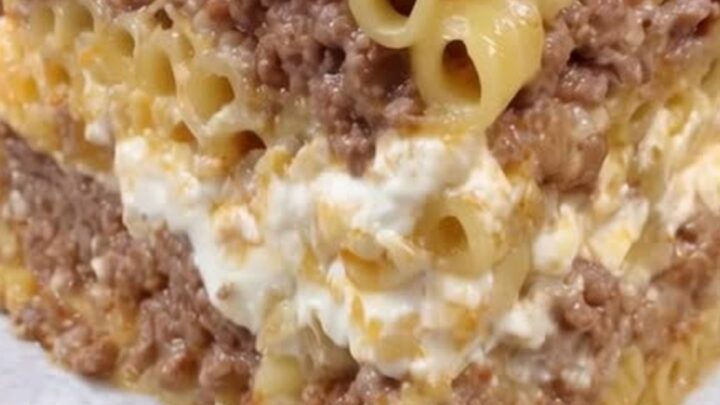
At the end of this phase, your baking dish should have two distinct, beautifully prepared layers. The tubular pasta forms a tight, even foundation at the bottom of the dish. The savory spiced beef sauce is spread evenly over the pasta, filling any gaps between the tubes. The surface should be flat and ready for the béchamel topping.
Béchamel and Baking
- Add the Béchamel and CheesePour the prepared béchamel sauce over the beef layer, smoothing it out with an offset spatula to cover the meat completely. Sprinkle the grated cheese evenly over the top of the béchamel to create the base for the golden crust.Look for The béchamel should completely seal the beef layer beneath it.Tip Spread the béchamel all the way to the edges of the dish.
- Bake Until Golden and BubblyPlace the baking dish in the preheated oven. Bake for 40 to 45 minutes until the béchamel is puffed, bubbly, and the cheese crust has turned a beautiful, deep golden-brown color.Look for The edges should be bubbling and the top crust golden-brown.Tip Rotate the dish halfway through baking for even browning.
By the end of this phase, the pastitsio is fully baked and has a stunning appearance. The thick béchamel layer has puffed slightly and baked into a golden, bubbly cheese crust. The edges of the casserole should be bubbling gently, and the aroma of warm spices and toasted cheese should fill the kitchen.
Resting and Slicing
- Rest the Baked PastitsioRemove the pastitsio from the oven and place it on a wire rack. Let it rest undisturbed at room temperature for at least 30 minutes, and no more than two hours, before slicing. This resting period allows the layers to firm up and set.Look for The casserole should feel firm and hold its shape when gently nudged.Tip Do not skip this step, or the slices will collapse.
- Slice and ServeUsing a sharp chef's knife, cut the rested pastitsio into tall, clean square slices. Carefully lift each slice onto a plate using a spatula, showing off the perfectly defined layers of pasta, meat, and golden cheese crust.Look for The slices should stand tall on the plate without falling apart.Tip Wipe the knife blade with a damp paper towel between cuts.
At the final checkpoint, the pastitsio has rested and cooled slightly. The top crust should be firm to the touch and crackle slightly when cut with a sharp knife.
When you lift a square slice onto a plate, it must stand tall and firm without collapsing, showcasing the perfect, clean stratification of pasta, meat, and golden cheese crust.
Common mistakes
One of the most common mistakes is slicing the pastitsio too soon after it comes out of the oven. Slicing a hot pastitsio will cause the layers to slide and collapse into a messy heap on the plate.
Another frequent error is using a watery beef sauce. If the sauce has too much liquid, it will seep into the pasta layer, making it soggy and preventing the casserole from holding its shape when sliced.
How to tell it’s done
To determine if your pastitsio is perfectly cooked, look for a deeply golden-brown, slightly puffed cheese crust with bubbling edges.
Since the components are already cooked, the baking process is primarily to heat everything through, melt the cheese, and allow the béchamel to set into a firm, sliceable custard. The pastitsio is done when the center is hot throughout and the top crust is beautifully caramelized.
Up next · Part 3 of 3
2 variations · storage & make-ahead · 4 answers · printable card
Tips, FAQ & printable recipe (Part 3)← Back to the ingredients (Part 1)