Dinner · Part 2 of 3: Instructions
Apple Cider BBQ Country Pork Ribs: 5-Ingredient Slow Cooker Dinner Step-by-step instructions
- Prep
- Cook
- Total
- Serves
- 6
Before you start
Before starting, gather all the ingredients and a 6-quart slow cooker. Core and slice the apples into 1/2-inch thick wedges; no need to peel them. Measure the apple cider and have the BBQ sauce bottle ready.
If the ribs are very thick, you can cut them into smaller pieces to fit the slow cooker more evenly. There is no need to season the meat with salt, as the BBQ sauce provides plenty of flavor. Plug in the slow cooker and set it to LOW if you plan to cook for 6 to 8 hours, or HIGH for a shorter time.
Ingredients at a glance (4)
- 3 lb boneless country-style pork ribs
- 3 Honeycrisp apples, cored and sliced
- 1 cup unfiltered apple cider
- 1 1/2 cups thick Kansas City-style BBQ sauce
Instructions
Layer and Sauce
- Layer the Ribs and ApplesPlace the boneless country-style pork ribs in the bottom of a 6-quart slow cooker, arranging them in a single layer if possible. Scatter the sliced Honeycrisp apples over the ribs. Pour the unfiltered apple cider around the edges of the slow cooker, trying not to rinse the apples off the meat.Look for The ribs should be mostly covered by the apples, and the cider should pool around the sides without submerging the meat.Tip For even cooking, choose ribs of similar thickness. If some are thicker, place them in the center where heat is more consistent.
- Pour the BBQ Sauce OverDrizzle the thick Kansas City-style BBQ sauce evenly over the ribs and apples. Use a spoon or spatula to spread it gently, covering as much surface as possible. Do not stir; the layers will meld during cooking.Look for The sauce should form a glossy, even layer over the apples and ribs.Tip If your BBQ sauce is very thick, warm it slightly to make it easier to pour.
In this first phase, the slow cooker holds a neat layer of ribs, topped with sliced apples and cider, with a thick blanket of BBQ sauce over everything.
The ingredients should be arranged evenly, and the sauce should cover the apples and meat without being stirred. The slow cooker is ready to be turned on, and the kitchen is quiet with anticipation.
Slow Cook to Tender
- Cover and Cook Low and SlowCover the slow cooker with the lid and cook on LOW for 6 to 8 hours, or on HIGH for 3 to 4 hours. The ribs are done when they are fork-tender and easily pull apart. Avoid opening the lid during cooking to keep the heat and moisture steady. Let it rest for 3 minutes before slicing.Look for The sauce will be bubbling gently around the edges, and the kitchen will smell of apple and smoke.Safe temperature 145°F (63°C) internal temperature (steaks, chops and roasts)Tip If cooking on HIGH, check at the 3-hour mark; cooking times can vary with different slow cookers.
- Check the Internal TemperatureAfter the minimum cooking time, use an instant-read thermometer to check the internal temperature of the thickest rib. It should read at least 145°F (63°C). For fall-apart tenderness, let the ribs continue cooking until they shred easily with a fork. Let it rest for 3 minutes before slicing.Look for The thermometer should slide in easily, and the meat should be tender when pierced.Safe temperature 145°F (63°C) internal temperature (steaks, chops and roasts)Tip Country-style ribs are best when cooked beyond 145°F (63°C) to 190°F (88°C) for maximum tenderness.
- Let the Ribs RestTurn off the slow cooker and let the ribs rest in the sauce for 10 minutes. This allows the juices to redistribute and the sauce to thicken slightly. Use a spoon to baste the ribs with the sauce before serving.Look for The sauce will be slightly thicker and cling to the ribs.Safe temperature 145°F (63°C) internal temperature (steaks, chops and roasts)Tip Resting in the sauce keeps the ribs moist and adds flavor.
After hours of gentle cooking, the sauce is bubbling around the edges, and the aroma of apples and smoke fills the kitchen. The ribs are fork-tender, and the apples have softened into a jammy compote. The sauce has thickened and clings to the meat. The internal temperature has reached at least 145°F (63°C), and the meat is ready to rest.
Rest and Serve
- Serve the Ribs with Apples and SauceUsing a carving fork, lift the ribs out of the slow cooker and place them on a serving platter. Spoon the cooked apples and extra sauce over the top. Serve hot, with additional sauce on the side if desired.Look for The ribs should be glistening with sauce, and the apples soft and caramelized.Tip For a complete meal, serve with mashed potatoes or crusty bread to soak up the sauce.
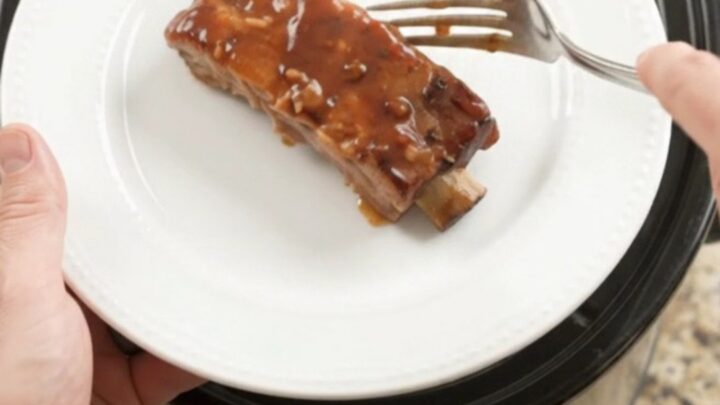
The ribs have rested in the sauce, absorbing even more flavor. When lifted with a fork, they glisten with a sticky, mahogany glaze. The apples are soft and caramelized, and the sauce is thick enough to coat a spoon. Plated on a white dish, the ribs look rustic and inviting, with steam rising and the promise of a satisfying meal.
Common mistakes
One common mistake is lifting the lid too often to check on the ribs. Each time the lid is removed, heat and steam escape, which can extend cooking time. Another mistake is using a thin BBQ sauce; it will not create the desired glaze.
Also, do not stir the ingredients after adding the sauce, as this can break up the apples and create a watery sauce. Finally, avoid overcooking on HIGH, which can make the meat dry and stringy. Stick to the suggested times and rely on a thermometer for doneness.
How to tell it’s done
The ribs are done when they are fork-tender: a fork should slide into the meat with little resistance, and the meat should easily pull apart. The internal temperature should read at least 145°F (63°C) on an instant-read thermometer, but for fall-apart tenderness, cook until the meat reaches about 190°F (88°C).
The apples should be soft and translucent, and the sauce should be thick and bubbling. If the sauce seems too thin at the end, remove the lid and let the slow cooker cook on HIGH for an additional 20 to 30 minutes to reduce.
- Steaks, chops and roasts: 145°F (63°C) in the thickest part, then a 3-minute rest
Up next · Part 3 of 3
4 variations · storage & make-ahead · 5 answers · printable card
Tips, FAQ & printable recipe (Part 3)← Back to the ingredients (Part 1)