Breakfast · Part 2 of 3: Instructions
Antep Katmer: Crispy Phyllo with Kaymak & Pistachios Step-by-step instructions
- Prep
- Cook
- Total
- Serves
- 4
Before you start
Before starting, ensure your phyllo is thawed if frozen and at room temperature. Measure all ingredients and have them ready. Preheat your oven to 425°F (220°C) and butter your baking sheet or pan.
Prepare a clean, dry work surface for assembling the katmer. Have a pastry brush and a pizza wheel or sharp knife on hand for later steps.
Ingredients at a glance (5)
- 4 sheets paper-thin katmer phyllo (or yufka)
- 150 g clotted cream (kaymak)
- 100 g crushed green pistachios
- 2 tbsp granulated sugar
- 4 tbsp unsalted butter, melted
Instructions
Assemble the Layers
- Prepare the PhylloLay one sheet of katmer phyllo on a clean, dry surface. Brush the entire surface with melted butter, using a pastry brush to coat evenly. Repeat with the remaining sheets, stacking them one on top of the other, brushing each layer with butter.Look for The phyllo should be lightly glossy from the butter but not soggy.Tip Keep phyllo covered with a damp cloth while working to prevent drying.
- Add the FillingSpread the clotted cream (kaymak) evenly over the center of the buttered phyllo stack, leaving a border around the edges. Sprinkle the crushed pistachios and granulated sugar over the cream.Look for The filling should be distributed in an even layer, not piled high.Tip Use a spatula to spread the cream gently without tearing the phyllo.
The phyllo sheets are buttered and stacked, and the filling is spread evenly in the center. The edges are clean and the phyllo is still pliable. The stack should look neat, with no dry edges or cracks. The butter gives a glossy sheen, and the pistachios and sugar are visible in a thick, even layer.
Fold and Bake
- Fold into a PacketFold the edges of the phyllo over the filling to form a neat rectangular envelope. Fold the bottom edge up, then the top edge down, and finally the sides inward, pressing gently to seal.Look for The packet should be tight and even, with no filling leaking out.Tip Brush the folded packet with a little more butter to help it crisp.
- Bake Until GoldenPlace the folded katmer on a buttered baking sheet or round copper pan. Bake in a preheated oven at 425°F (220°C) for 10 minutes, until the top is blistered and golden brown.Look for The pastry should be deep golden with darker blisters on top.Tip Rotate the pan halfway through for even browning.
The katmer is folded into a tight rectangular packet, with no filling escaping. It sits on the buttered pan, ready for the oven. As it bakes, the top turns golden and blistered, and the aroma of butter and nuts fills the kitchen. The pastry puffs slightly, and the edges become deeply browned.
Slice and Serve
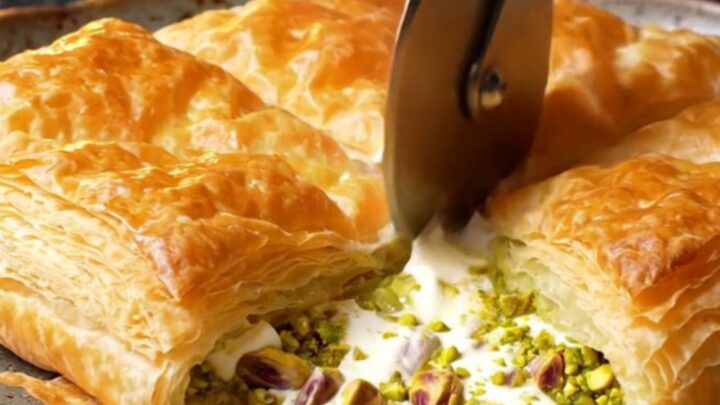
- Slice and ServeRemove the katmer from the oven and let it cool for 2 minutes. Using a pizza wheel or sharp knife, cut the pastry into 4 triangles. Serve immediately while the cream is molten and the pastry is crisp.Look for A loud flaky crackle should sound as you cut through the crisp layers.Tip Serve on a warm plate to keep the pastry crisp longer.
The baked katmer is golden and crisp, with visible blisters. Cutting into it produces a loud crackle, revealing the molten cream and bright green pistachios inside.
Steam rises from the cut, and the filling oozes slightly. The pastry is served warm, with the layers shattering at the touch of a fork.
Common mistakes
One common mistake is overfilling the katmer, which can cause the phyllo to tear or the filling to leak during baking. Keep the filling in a neat, even layer. Another pitfall is under-baking, which results in a pale, doughy pastry.
Ensure the oven is fully preheated and bake until the top is truly golden and blistered. Finally, avoid cutting the katmer too soon after baking; a brief rest allows the layers to set and prevents the filling from running out completely.
How to tell it’s done
The katmer is done when the top is deeply golden and blistered, with darker spots indicating caramelization. The pastry should feel crisp and firm to the touch, but still slightly pliable.
If you tap it, it should sound hollow. Let it rest for 2 minutes before cutting to allow the filling to set slightly, but serve while the cream is still warm and molten.
Up next · Part 3 of 3
4 variations · storage & make-ahead · 5 answers · printable card
Tips, FAQ & printable recipe (Part 3)← Back to the ingredients (Part 1)